How to Organize Your Pantry: Simple Systems That Actually Work
A beautiful pantry is nice to look at. A pantry that actually makes your kitchen easier to use is even better.
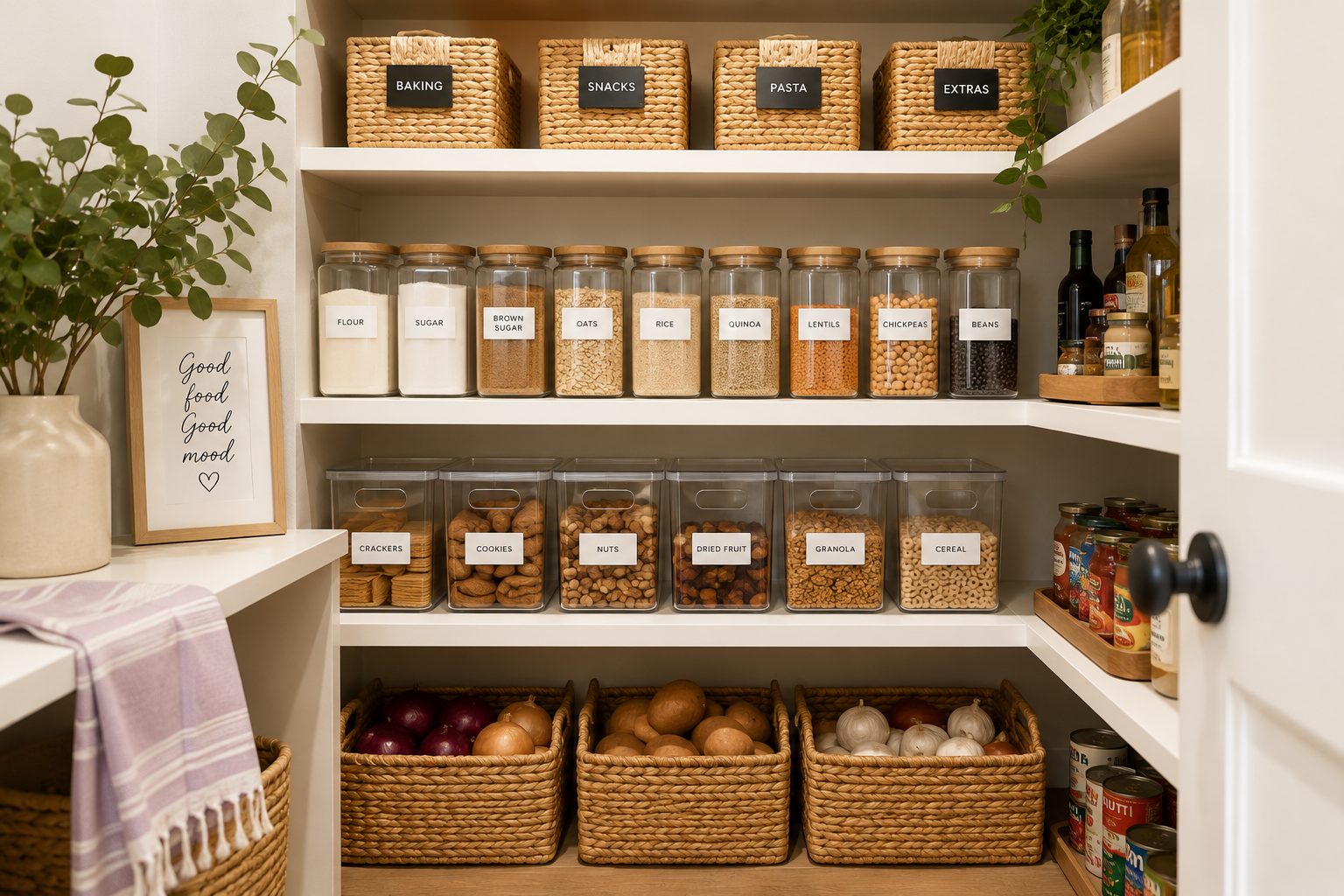
For me, good pantry organization comes down to three simple things. I want to be able to see what I have, find what I need and put things away easily.
One thing that makes a surprisingly big difference is the depth of your pantry shelves.
A pantry with shelves around 12 inches deep has very different challenges from one with shelves closer to 24 inches deep. Organizing both the same way can leave you with wasted space or food disappearing behind other food.
The good news is that you don’t need dozens of organizers to fix either problem. You just need to choose solutions that make sense for the space you actually have.
Start With a Pantry Reset
Before you buy anything, start with what you already have.
Take everything out, check expiration dates and sort what you’re keeping, donating or tossing. Group similar foods together and think about the zones that make sense for the way you actually use your kitchen. Make note of anything that needs to be used soon or replaced.
Then put things back and live with the new arrangement for a little while before buying every organizer you think you might need.
You may discover that one shelf needs a riser, another needs a pull-out bin and another doesn’t need anything at all.
I’ve found that the best organization systems work with the way you naturally use a space. You shouldn’t have to change all of your habits just to keep your pantry organized.
Ready to Reset Your Pantry?
I created a free Pantry Reset Checklist to make the process easier. It walks you through clearing everything out, deciding what stays, planning your pantry zones and putting everything back in a way that works for your space.
There’s also room to keep track of items to use soon, organizers you may need and a pantry restock list you can keep handy for the things you’re running low on.
Measure before you Organize
Before ordering bins, baskets or containers, grab a tape measure.
Measure the width, depth and height of your shelves. If your shelves are adjustable, think about whether changing the height of one or two could make the space more functional.
This is especially important if you’re considering stepped risers, shelf risers, deep pull-out bins or a pull-down organizer. All of these need enough clearance to work properly.
It’s also worth measuring each shelf individually. What looks like a 24-inch-deep pantry may have less usable space because of the door frame, hinges or other hardware.
Once you know what you’re working with, you can choose organizers that solve an actual problem rather than simply filling the pantry with more containers.
How to Organize a Shallow Pantry
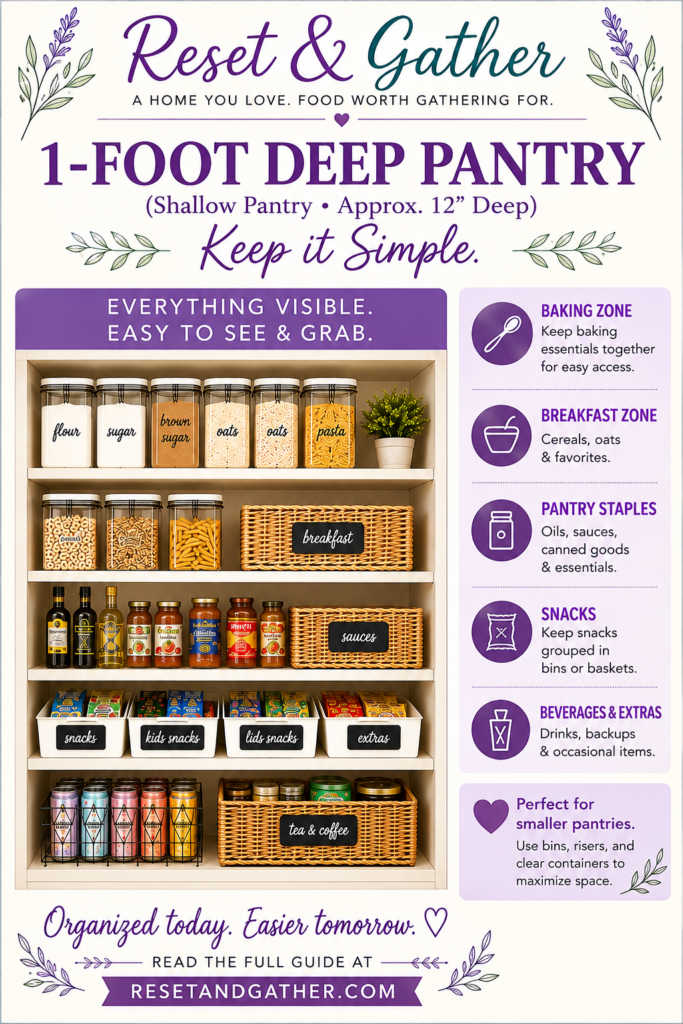
If your shelves are around 12 inches deep, you already have one big advantage: visibility.
There isn’t as much room for things to disappear behind one another, so you usually don’t need complicated storage systems.
Instead, concentrate on creating simple zones based on how you actually use your kitchen.
Creating a Baking Zone
Keep the ingredients you regularly use for baking together.
Flour, sugar, brown sugar, powdered sugar, baking powder, baking soda, cocoa and other staples are much easier to work with when they’re all in one place.
I keep my own baking staples in clear containers. It has made a bigger difference than I expected.
I can quickly see what I have before I start baking, grab what I need and put each ingredient straight back when I’m finished using it. That simple routine also helps keep the kitchen cleaner while I’m baking because I don’t end up with every ingredient sitting on the counter until the recipe is finished.
I’ll share my full baking-zone setup in another article because there are a few simple things I’ve found make both baking and cleanup much easier.
Keep Breakfast Together
Cereal, oatmeal, granola and other breakfast foods can live in their own section.
Small baskets are useful for packets and loose items, but don’t feel that everything needs to go into a bin.
If something is easier to see and grab sitting directly on the shelf, leave it there.
Give Everyday Staples Prime Space
The ingredients you reach for regularly should be some of the easiest things to access.
Keep oils, sauces, canned goods and other everyday cooking ingredients together and within comfortable reach.
On shallow shelves, a single visible row can sometimes work better than putting another container around everything.
Corral Snacks
Snacks are one category where baskets can make a noticeable difference.
Grouping similar items together gives everyone an obvious place to look. Just as importantly, it gives them an obvious place to put things back.
Use Lower Shelves for Heavier Items and Extras
Drinks, bulk items and heavier products generally work well on lower shelves.
This is also a useful place for extras and overflow items that you don’t need to access every day.
How to Organize a Deep Pantry
A pantry with shelves around 24 inches deep gives you considerably more storage space, but it creates a different problem.
Things disappear at the back.
You buy another can of tomatoes because you can’t see the three already sitting behind something else. A half-used bag gets pushed to the back. Eventually you find ingredients you forgot you owned.
The goal with a deep pantry is to use the full depth of the shelf while still being able to see and reach what you’ve stored there.
Use Stepped Risers for Cans and Jars
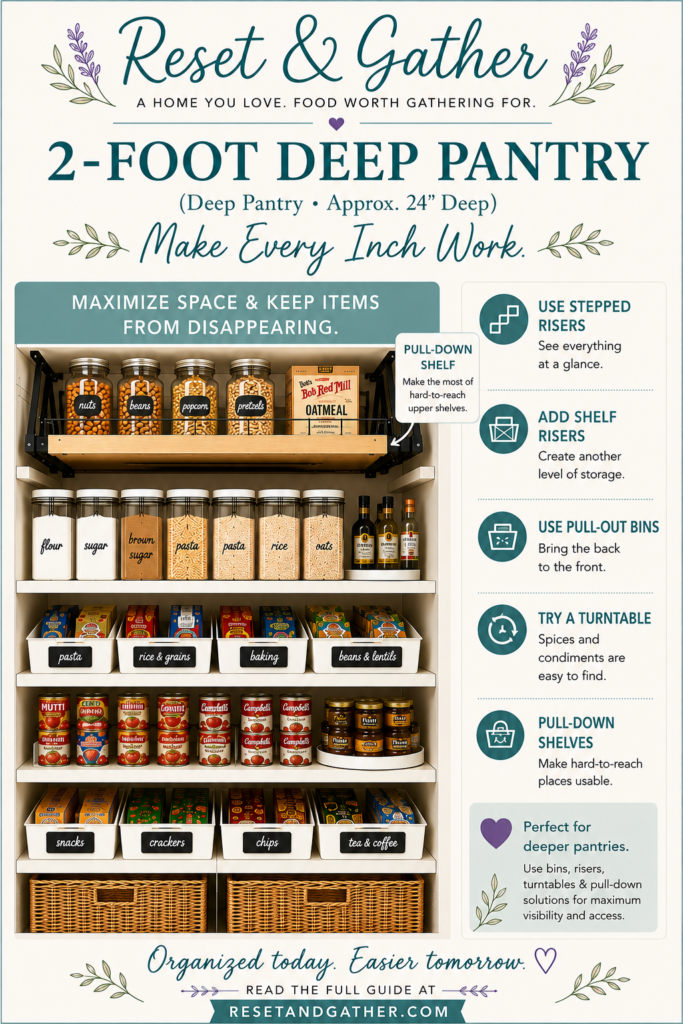
For cans and jars, stepped risers are one of my favourite solutions for deep shelves.
Instead of placing several rows of cans at the same height, a three-tier riser elevates each row. That means you can actually see what’s sitting at the back without moving everything in front of it.
They’re particularly useful for canned vegetables, soup, beans, sauces and jars.
You do need enough height between shelves to accommodate the upper tiers and the products sitting on them. If your pantry shelves are adjustable, this may be one place where increasing the shelf height makes the space much more functional.
Create Another Level With Shelf Risers
Sometimes you don’t need a stepped riser. You simply need to make better use of the empty space above shorter items.
I use wire shelf organizers in several areas of my pantry, including for canned goods. They create a second level so I can store items underneath and above without stacking them directly on top of one another.
I particularly like this approach when there’s plenty of height between pantry shelves. It turns otherwise unused vertical space into useful storage while still keeping everything easy to see and reach.
The stepped and flat shelf risers solve slightly different problems. If visibility from front to back is your issue, stepped risers work beautifully. If you have unused height above your food, adding another level may be the better solution.
Choose Pull-Out Bins That Use the Depth
Putting a standard 12-inch-deep bin onto a 24-inch shelf doesn’t really solve the deep-pantry problem. You can end up with another 12 inches of inaccessible or unused space behind it.
For a genuinely deep pantry, look for longer pull-out bins or drawers that use most of the available shelf depth.
Depending on your pantry, something around 20 to 22 inches deep may work well. Always measure the actual usable space first.
When the whole bin slides forward, the contents at the back come to you instead of requiring you to unload everything in front.
Use a Two-Tier Turntable for Spices
Spices are particularly easy to lose in a deep pantry because the jars are small and tend to hide behind one another.
I use a two-tier turntable for my spices, and it’s one of those simple changes that makes the space much easier to use.
The two levels make use of the vertical space on the shelf. Instead of moving several jars around to find what I need, I can simply rotate the organizer.
Mine also has an adjustable upper tier, which is helpful when you have spice jars of different heights.
It’s a good example of an organizer solving a real problem rather than simply making a shelf look organized.
Make High Shelves Come to You
Deep upper shelves can be especially frustrating because you’re dealing with both height and depth.
A pull-down shelf organizer can make that space much more usable by bringing the contents forward and down.
These systems are more of an investment and require careful measuring, so I wouldn’t choose one based on appearance alone. Cabinet width, depth, mounting requirements, weight capacity and clearance all matter.
Use Deep Drawers or Bins for Packaged Foods
Bags and packets can become messy quickly on a deep shelf.
A full-depth pull-out drawer or bin can work well for crackers, chips, snacks, coffee, tea and other packaged foods.
Instead of reaching into the back of the pantry, you can pull the entire category toward you.
Don’t Organize Just for the Picture
It’s easy to look at a beautiful pantry online and feel like you need dozens of matching containers.
You don’t.
I like clear containers for foods where they genuinely make my life easier. Baking staples are a perfect example. For plenty of other foods, the original packaging may be the most practical option.
The same applies to baskets, risers and turntables.
Before buying an organizer, ask yourself one question:
What problem is this going to solve?
If you don’t have a good answer, you may not need it.
I really like this section as written. It reinforces that Reset & Gather is about practical systems, not buying things just to achieve a certain look.
What I Use in My Pantry
Some of the organizers in my pantry have earned their place because they solve a specific problem and make the space easier to use.
These are products I actually use in my own pantry. I’m sharing them because they work for me, not because I think every pantry needs them.
Progressive ProKeeper Containers
I use Progressive ProKeeper containers for my baking staples.
What I especially like is that they aren’t simply matching clear containers. The collection has thoughtful features designed around different baking ingredients, which makes them genuinely useful when I’m baking.
I can see what I have at a glance, grab an ingredient, measure what I need and put the container straight back into my baking zone. That simple routine helps keep ingredients from accumulating on the counter while I’m working.
The containers are also sturdy and stack well. That makes it easier to use the vertical space in my baking zone while keeping everything neat, stable and easy to access.
Why I like them: clear storage, airtight seals, sturdy construction, stackable design, thoughtful baking features and easy access for measuring.
Hebayy 612 Script Pantry Food Labels
I added simple script labels to my pantry containers, and I love the finished look they give the space.
I use the Hebayy 612 Script Pantry Food Labels. The set includes labels for a wide range of pantry and baking staples, which makes it easy to keep a consistent look throughout the pantry.
They’re also water and oil resistant, which is useful in a working pantry where containers are regularly being handled while cooking and baking.
Labels certainly aren’t essential for good organization, but I like being able to identify ingredients quickly, and they add a simple finishing touch without making the pantry feel overdone.
Why I like them: lots of label options, easy-to-read script, a consistent look and water- and oil-resistant material.
YouCopia Crazy Susan Two-Tier Turntable
For my spices, I use the YouCopia Crazy Susan Two-Tier Turntable.
I like having two levels because it makes much better use of the vertical space on the shelf. The upper tier is adjustable, which helps accommodate spice jars of different heights.
The organizer rotates, so instead of moving several jars around to find the one I need, I can simply turn it and bring the spices at the back within easy reach.
For a collection of small jars that can easily disappear behind one another, I’ve found this much easier than trying to keep everything visible in rows.
Why I like it: two-tier storage, adjustable upper level, easy access to spices at the back and better use of vertical space.
ROFAY Wire Shelf Organizers
I use ROFAY wire shelf organizers in several areas of my pantry, including for canned goods.
They create another usable level within a tall shelf, which is particularly helpful when there’s a lot of empty space above shorter items.
Rather than stacking cans or leaving that vertical space unused, I can store items both above and below the shelf organizer while still being able to see and reach what I need.
I also like that they don’t require any installation. I can move them around as my pantry changes and use them wherever I need a little more shelf space.
Why I like them: sturdy, flexible storage, no installation required, better use of vertical space and easy to move as your pantry needs change.
The Goal Isn’t a Perfect Pantry
Your pantry doesn’t need to look like no one lives in your house.
It needs to work on a busy Tuesday when groceries are being put away, someone is looking for a snack and you’re trying to get dinner started.
If you can see what you have, reach what you need and put things back without thinking too much about it, you’ve created a system that works.
And that’s the kind of organization that’s much more likely to stay organized.
Organize today. Easier tomorrow. ♡